Income Inequality

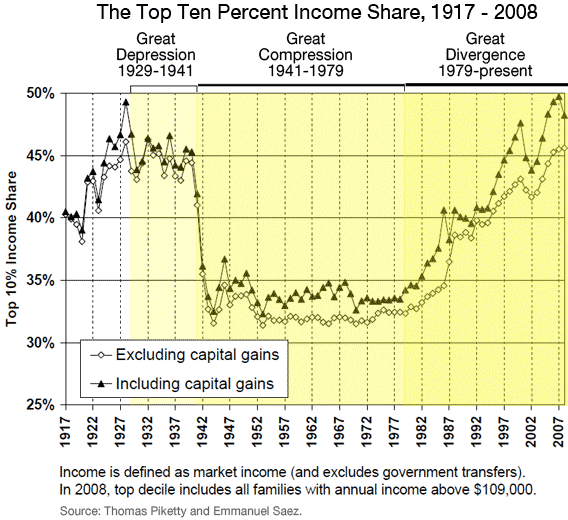
Timothy Noah published an interesting series on income inequality in Slate last month. Since about 1980 there has been a huge change in income inequality so that now the top 10% earn 50% of all income in the U.S.  The top 1% earn 25%, and the top 0.01% earn 6%.

Is it time for a revolution?

Edit

Interesting study about American’s beliefs and attitudes about income inequality here (pdf).

Posted in Uncategorized | Comments Off on Income Inequality

Another critique of the “Pledge to America”

This one by Edward Luce in the Financial Times, summarized by Brad deLong here.

A quote from the full article in the Financial Times:

Either the Republican Party believes what it is saying, in which case it has no further useful intellectual contribution to make. Or else it thinks the US electorate is intellectually challenged and will mistake this fantasy for a plan.

Posted in Uncategorized | Comments Off on Another critique of the “Pledge to America”

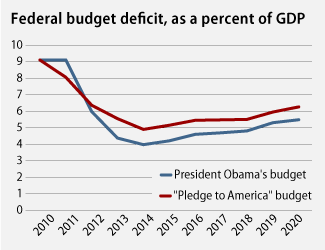
The “Pledge to America” results in a worse deficit in 2020 than Obama’s budget

I don’t have time to do this right, but here is the link. I’ll flesh this out in a day or two.  Here is the bottom line:

Posted in Uncategorized | Comments Off on The “Pledge to America” results in a worse deficit in 2020 than Obama’s budget

Port Townsend Wooden Boat Festival 2010

Posted in Uncategorized | Comments Off on Port Townsend Wooden Boat Festival 2010

Can we balance the budget with the Republican’s tax/spending cuts?

Short answer: No

Howard Gleckman of the Tax Policy Center posted this analysis of how one might balance the budget by 2020, given the permanent extension of Bush’s tax cuts.  This is to be accomplished by making vague spending cuts — and, by the way, not touching Social Security, Medicare, Defense and Veteran’s benefits, and interest payments — more or less what the Republicans sometimes say they want to do (when they’re not talking about privatizing Social Security).  The result of the analysis is that you will be left with essentially no government:

“What’s left? Well, McConnell would have to abolish all the rest of government to get to balance by 2020. Everything. No more national parks, no more Small Business Administration loans, no more export subsidies, no more NIH. No more Medicaid (one-third of its budget pays for long-term care for our parents and others with disabilities). No more child health or child nutrition programs. No more highway construction. No more homeland security. Oh, and no more Congress. No more nothin’.

We’re not talking about a temporary 1995-like government shut-down here. We are talking about a government that exists only to fund national defense, provide benefits to the already- or soon-to-be retired, and pay interest to the Chinese and our other lenders.”

Posted in Uncategorized | Comments Off on Can we balance the budget with the Republican’s tax/spending cuts?

So How Did the Bush Tax Cuts Work Out for the Economy?

I couldn’t resist using the original title — David Cay Johnston of Tax.com has done a thorough and scathing analysis of the results of Bush 43’s two tax cuts.  His conclusions —

“The tax cuts did not spur investment. Job growth in the George W. Bush years was one-seventh that of the Clinton years. Nixon and Ford did better than Bush on jobs. Wages fell during the last administration. Average incomes fell. The number of Americans in poverty, as officially measured, hit a 16-year high last year of 43.6 million, though a National Academy of Sciences study says that the real poverty figure is closer to 51 million. Food banks are swamped. Foreclosure signs are everywhere. Americans and their governments are drowning in debt. And at the nexus of tax and healthcare, Republican ideas perpetuate a cruel and immoral system that rations healthcare — while consuming every sixth dollar in the economy and making businesses, especially small businesses, less efficient and less profitable.

This is economic madness. It is policy divorced from empirical evidence. It is insanity because the policies are illusory and delusional. The evidence is in, and it shows beyond a shadow of a reasonable doubt that the 2001 and 2003 tax cuts failed to achieve the promised goals.

So why in the world is anyone giving any credence to the insistence by Republican leaders that tax cuts, more tax cuts, and deeper tax cuts are the remedy to our economic woes? Why are they not laughingstocks? It is one thing for Fox News to treat these policies as successful, but what of the rest of what Sarah Palin calls with some justification the “lamestream media,” who treat these policies as worthy ideas?

The Republican leadership is like the doctors who believed bleeding cured the sick. When physicians bled George Washington, he got worse, so they increased the treatment until they bled him to death. Our government, the basis of our freedoms, is spewing red ink, and the Republican solution is to spill ever more.

Those who ignore evidence and pledge blind faith in policy based on ideological fantasy are little different from the clerics who made Galileo Galilei confess that the sun revolves around the earth. The Capitol Hill and media Republicans differ only in not threatening death to those who deny their dogma.

How much more evidence do we need that we made terrible and costly mistakes in 2001 and 2003?”

Posted in Uncategorized | Comments Off on So How Did the Bush Tax Cuts Work Out for the Economy?

Interesting, but flawed, Dem/Rep presidential comparison

A few days ago, Allen Edwards posted on Facebook this thought-provoking comment:

If you took $10,000 to invest 50 years ago, and followed the pattern of investing in the S&P 500 during GOP presidencies, and at 5% in bonds & bank accounts during Democratic presidencies, you’d have about $60,000 today. If you took the same $10,000 and reversed this, investing in the S&P only during Democratic presidencies, and keeping it in bonds & accounst earning 5% during GOP presidencies, you’d have about $350,000 today.

I had to check it, of course.  I downloaded monthly S&P historical data from Yahoo for the period 1960 to the  present, set up a spreadsheet to do the calculations (ignoring dividends and compounding interest monthly), and this is what I got:

Value at end of President’s Term in  office
Invest in S&P 500 with Dem Pres; 5% bonds with GOP Pres Invest in S&P 500 with GOP Pres; 5% bonds with Dem Pres
Starting amount: 10,000 10,000
End of term of:
Kennedy/Johnson 18,600 14,700
Ford 25,500 15,400
Carter 33,300 18,000
Reagan 49,600 39,700
Bush 41 61,100 60,500
Clinton 189,100 84,000
Bush 43 227,500 56,200
Obama (Sept ’10) 351,100 60,800

Note that the big changes occur during Clinton’s term and Bush 43’s term — investing in the S&P while Clinton was in the White House tripled your portfolio, and getting out of the market during Bush 43’s term allowed you to keep it.

Edit

I should have also posted what you would have if you left your money in the S&P 500 for the entire time — you’d have $204,000.  If your investment strategy was to get out of the market whenever a Democrat was president, you’d have paid a severe penalty for missing the Clinton  years.

Another Edit

This really doesn’t say anything about which party is better for the market.  The gain during Clinton’s presidency was due to the dot-com bubble; the loss during Bush was due to the collapse of the housing bubble and resulting financial crisis.  One could argue that the collapse was because of Republican policies, but that’s another story.

Posted in Uncategorized | Comments Off on Interesting, but flawed, Dem/Rep presidential comparison

What do businesses consider their most important problem?

Here is a chart (via Krugman) compiled yearly of what business people consider their biggest problem.  Note that since 2009 sales is the largest problem by a significant margin.  This is why they aren’t hiring — not uncertainty.

Posted in Uncategorized | Comments Off on What do businesses consider their most important problem?

Fannie and Freddy again

More evidence that Fannie Mae and Freddy Mac were not drivers of the housing bubble.  Here is a graph from the conservator’s report:

It says that Fannie and Freddie were, for the most part, on the sidelines during the peak of the housing bubble.

From a summary (Paul Krugman) of a summary (Karl Smith) of the actual report.

Posted in Uncategorized | Comments Off on Fannie and Freddy again

Ryan’s Roadmap

Earlier this year, Rep. Paul Ryan (R) presented a fiscal roadmap for Republicans that he claimed would cut the deficit in half by 2020.  At his request,  the CBO analyzed a version of the  plan and agreed that the version they were asked to analyze would indeed cut the deficit in half by 2020.  What Ryan (and Republicans in general) don’t say is that the plan the CBO was asked to analyze was only half of  Ryan’s roadmap — the half that comprised his  spending cuts.  When you include the other half — his tax cuts — the deficit in 2020 is as large as ever.  See this and this.  Republicans are not serious about deficit reduction — they just want us to think they are.

Edit:  Also see this.

Posted in Uncategorized | Comments Off on Ryan’s Roadmap