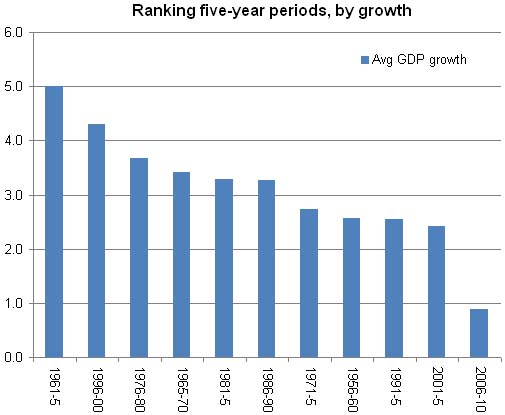
Were the Bush Tax Cuts Good for Growth? – NYTimes.com.
No, they weren’t.
The GAO has released its fall 2010 update for the Federal Government’s long-term fiscal outlook. The bottom line is that we must come up with a real plan, and soon, to deal with the ever-growing cost of Medicare, Medicaid, and Social Security — but, of course, we knew that already. What’s new (I think) is that the report credits the cost-control provisions of the ACA with postponing the day of reckoning — as long as we don’t succumb to the temptation to weaken them. The ACA is a net deficit reduction act — according to both the CBO and Medicare trustees. If the Republicans want to repeal it, they need to find new funds to make up for those lost by the bill’s repeal.
Unserious People – NYTimes.com.
The co-chairs of the deficit commission have produced a report that, if followed, will turn us into a third-world country. It seems to be a very poorly-thought-out set of recommendations. That commission, as Brad DeLong notes, is another of Obama’s unforced errors. More later.
Paul Krugman on the Strange Death of Expansionary Fiscal Policy – Grasping Reality with Both Hands.
A plurality of voters want to see a new economic stimulus bill–called a stimulus–to create jobs. Even 18% of Republicans and 32% of independents think a new job-creating stimulus bill should be Congress’s highest priority. Yet is Congress going to pass one? No. Is the Treasury leveraging up its TARP money and using it to stimulate the economy? No. The Federal Reserve–well, the forecasts are that the Federal Reserve’s quantitative easing programs may add between 0.2% and 0.5% to economic growth next year, although I do not see how the estimates can be so high unless the program has a large effect on inflation expectations.
This is an absolutely remarkable government that we have. And an absolutely remarkable political class.
The Strange Death of Fiscal Policy – NYTimes.com: One clear result of the midterms is that we won’t have anything like a further round of stimulus. And this, in turn, means that the narrative all the Very Serious People will tell is that fiscal policy was tried, it failed, and that’s that.
But the real facts don’t at all support the conventional wisdom.
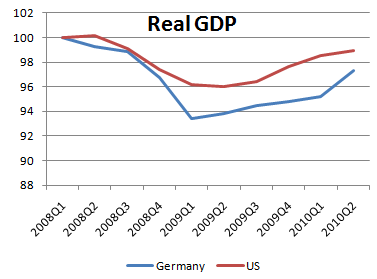
Actually, let me focus on an international comparison. You often hear the US experience contrasted with Germany: America, we’re told, went for Keynesian policies, while Germany chose austerity, and Germany did better.
But as far as GDP is concerned, Germany did not, in fact, do better:
Follow the links for the rest.
From Jeff Madrick at TripleCrisis:
…The deficit hawks have also largely won in the U.S. The announcement last week that GDP grew at an annual rate of 2 percent only brings the point home: the U.S. needs a serious fiscal injection quickly. But it is not going to get it….
The real targets of the deficit hawks are Social Security, Medicare, and Medicaid.
An amazing video. Watch full-screen with HD on. Pause at first to let the video buffer get far enough ahead to enable it to play smoothly.
World Statistics in real time.
Did WWII really get us out of the Great Depression?
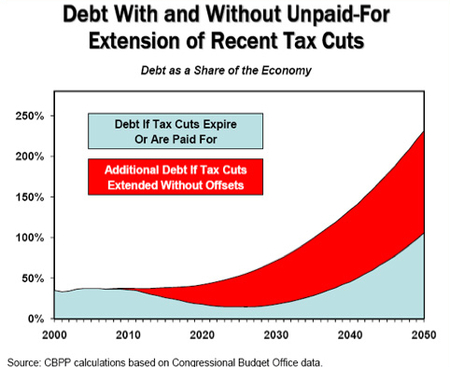
Here’s what will happen if Bush’s tax cuts are extended (from Ezra Klein ):